
Direct answer
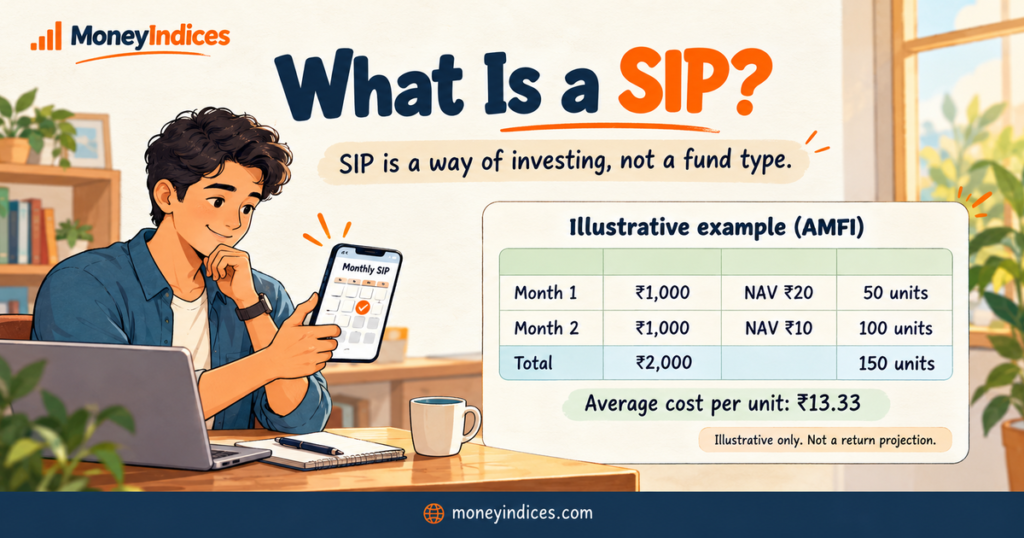
A Systematic Investment Plan (SIP) is a mode of investing a fixed amount in a mutual fund scheme at regular intervals — commonly monthly — instead of only investing a lump sum. It is not a separate fund type or asset class. Money is typically auto-debited from your bank account; each instalment buys units at that day’s applicable NAV.
For AMC / trust / NAV structure (what a mutual fund is), see What Is a Mutual Fund and How Does It Work?.
According to AMFI’s SIP explainer, SIP is a mode of investing. Returns remain market-linked. SIP does not guarantee profits or protect against losses in falling markets — AMFI’s rupee-cost averaging disclaimer on the same page.
Educational only, not investment advice. Mutual fund investments are subject to market risks, read all scheme related documents carefully.
What is SIP in plain English?
Think of SIP like a recurring deposit habit, but the “balance” is mutual fund units whose value can go up or down with markets — not a fixed bank interest credit.
Minimum SIP amounts vary by scheme and are stated in the SID/KIM; some schemes accept small monthly amounts. See the AMFI SIP page.
What happens on SIP day?
- Bank debits the SIP amount (via NACH/e-mandate or other supported modes the AMC offers).
- Funds must be available in the mutual fund’s account as per applicable cut-off/NAV rules.
- Units are allotted based on applicable NAV and amount.
- Units accumulate in your folio over time.
Because NAV changes, you usually receive a different unit count each instalment.


What is rupee-cost averaging — and what is it not?
Illustrative example (AMFI; hypothetical NAVs, not a real scheme): if you invest ₹1,000 when NAV is ₹20, you get 50 units; when NAV is ₹10, you get 100 units. Across both, ₹2,000 buys 150 units at an average cost of ₹13.33.
That averaging can reduce the impact of buying only at a market peak — but:
- It does not assure profit
- It does not protect against losses in declining markets
- It is a method of spreading purchases over time, not a reason in itself to keep investing regardless of whether the scheme still fits your goal
AMFI states this disclaimer language on its SIP page.
SIP vs lump sum — how do they compare?
| Point | SIP | Lump sum |
|---|---|---|
| Cash-flow fit | Aligns with monthly salary | Needs money available upfront |
| Timing risk | Spreads purchases over time | More exposed to a single entry date |
| Behaviour | Can automate regular investing | Requires self-control not to chase peaks |
| When markets fall | Instalments continue at lower NAVs unless paused or stopped | May feel painful if fully invested already |
| When markets rise quickly | Average cost may lag a lucky single entry | Early lump sum may benefit more in that scenario |
Editorial interpretation: Neither mode is universally superior. SIP often fits salaried cash flows; lump sum may be used when a large sum is already available and the investor accepts timing risk. Some investors use both (for example, invest a bonus partly as lump sum and continue SIPs). That is a description of behaviours, not a recommendation.
Why does tenure matter for compounding?
AMFI explains compounding as earning returns on reinvested earnings over time and publishes illustrative calculations at assumed rates (for example, an 8% illustration on their SIP education page). These are teaching tools — not forecasts of your scheme.
Starting earlier increases the number of compounding periods available — again, a math idea, not a promise of wealth.
How does starting a mutual fund SIP work? (process overview)
The steps usually involve:
- KYC (required for mutual fund investments under SEBI’s KYC norms and the Prevention of Money-laundering Act framework).
- Selecting a scheme after reading its SID/KIM: objective, risks, asset allocation, loads and related disclosures. See SEBI’s “Mutual Funds – Dos and Don’ts” investor sheet.
- Selecting the plan (direct vs regular). Direct plans typically have lower expense ratios because distributor commissions are not built into the plan the same way. See SEBI regular vs direct.
- Selecting the option (for example, growth vs IDCW, which differ in tax and cash-flow treatment).
- Registering the SIP amount, date, frequency and start/end (or perpetual, where offered).
- Setting up a bank mandate (NACH / e-mandate / other AMC-supported methods).
- Having an adequate bank balance before each debit date.
You can invest via AMC website/app, MF utilities platforms, or an AMFI-registered distributor.
Does NAV timing matter for SIP too?
AMFI documents that, under SEBI rules effective from 1 Feb 2021 (per circulars referenced on AMFI’s cut-off page), applicable NAV for purchases — including SIP — depends on realisation and availability of funds in the mutual fund’s bank account before cut-off, not merely the scheduled SIP calendar date. See AMFI cut-off / applicable NAV info.
Practical implication: Failed or late credits can mean a different NAV date than you expected.
What about exit loads, redemption, and stopping SIP?
- Stopping SIP stops future instalments; existing units remain invested until you redeem.
- Redemption sells units; equity schemes often have exit-load conditions for early exits (check SID). Each SIP instalment can have its own ageing for load calculation — scheme documents commonly explain this (often FIFO); verify in the SID/KIM for your scheme rather than treating booklet language as statute.
- Markets can be down when you need money — liquidity planning still matters.
Which SIP myths should you drop?
| Myth | Reality |
|---|---|
| “SIP guarantees returns” | False. Market-linked. |
| “SIP is only for equity funds” | SIP is a method; debt/hybrid schemes may also offer SIPs. |
| “Lower NAV is always better” | You care about suitability and progress to goal, not NAV vanity. |
| “I should stop SIP when markets fall” | Not necessarily a rule either way. When NAV is lower, the same instalment buys more units (AMFI), but averaging does not protect against losses in declining markets. The decision depends on whether the scheme still fits your goal, horizon and cash flow. |
| “More SIPs in more themes always = diversification” | Overlapping themes can concentrate risk. |
Related on MoneyIndices (behaviour / myth pieces — different intent from this definition hub):
What risks still apply with SIP?
SIP does not remove:
- Market / volatility risk
- Scheme-specific risk (credit risk in debt, concentration in sector funds, etc.)
- Inflation risk if returns lag inflation after tax
- Behavioural risk (pausing at the worst time)
- Liquidity risk if you invest money needed soon
SEBI’s risk taxonomy covers these ideas: SEBI key risks.
SIP vs “stock SIP” / other products
People also use the word SIP for scheduled buying of stocks or ETFs on broker apps. Those are broker features, not the mutual-fund SIP product AMFI describes. Rules, costs, and taxation differ. Always check which product you are actually buying.
FAQ
Is SIP safer than lump sum?
Safer is the wrong word. SIP spreads entry timing; lump sum concentrates it. Both can lose money in the same scheme.
Can I change SIP amount later?
Often yes (via modification flows AMC/app support). Rules vary; check your platform.
What if my SIP bounces?
If SIP instalments fail repeatedly, the fund house can cancel the SIP; the exact rule is in your scheme’s documents (SID).
Does SIP have a lock-in?
The SIP method itself does not create a universal lock-in. Some schemes (for example, ELSS) have lock-in on units. Exit loads may still apply.
How long should I run a SIP?
There is no fixed answer; tenure is usually matched to the goal horizon. Education materials emphasise long-term discipline; your date of need matters more than a viral “X years” rule.
SIP or STP?
STP (Systematic Transfer Plan) moves money between schemes (often liquid to equity) on a schedule. Different tool, used by some investors to stagger a lump sum into another scheme. Read scheme documents.
Can I align SIP with salary date?
Many AMCs let you pick an instalment date near salary credit so the debit clears after funds arrive — a cash-flow convenience, not a return strategy. Budgeting depth stays on the salary-saving guide.
External sources
- AMFI — Systematic Investment Plan: https://www.amfiindia.com/investor/become-mf-distributor?zoneName=sip
- AMFI — Cut-off timings & applicable NAV (incl. SIP): https://www.amfiindia.com/investor/knowledge-center-info?zoneName=CutOffTimingsAndNewRuleOnApplicableNAV
- SEBI Investor — Understanding mutual funds: https://investor.sebi.gov.in/understanding_mf.html
- SEBI — Mutual Funds: Dos and Don’ts (investor sheet): https://investor.sebi.gov.in/pdf/reference-material/MFunds.pdf
- SEBI Investor — Regular vs direct: https://investor.sebi.gov.in/regular_and_direct_mutual_funds.html
- SEBI Investor — Key risks: https://investor.sebi.gov.in/securities-risks_trade_derivatives.html
Disclaimer: This article is for educational purposes only and is not investment advice or a recommendation to buy, sell or hold any scheme. All examples are illustrative. Mutual fund investments are subject to market risks, read all scheme related documents carefully.
