
Health insurance is one of the most important financial protections you can buy. But when comparing policies, most people focus only on premium amount and coverage. Very few understand one critical metric that tells you whether an insurer is financially healthy and reliable — the Incurred Claim Ratio (ICR).
If you’ve ever wondered:
- What is incurred claim ratio?
- What is a good incurred claim ratio?
- Is higher ICR better?
- How is ICR different from claim settlement ratio?
This detailed guide will explain everything in simple language.
What is the Incurred Claim Ratio (ICR)?
Incurred Claim Ratio (ICR) is the percentage of total claims paid by an insurance company compared to the total premiums it collected in a financial year.
In simple words:
It shows how much of the money collected as premiums is actually used to pay policyholders’ claims.
Formula of Incurred Claim Ratio:
ICR = (Net Claims Paid ÷ Net Premium Collected) × 100
Example:
- Total Premium Collected = ₹100 crore
- Total Claims Paid = ₹75 crore
ICR = (75 ÷ 100) × 100 = 75%
This means the insurer paid ₹75 for every ₹100 collected.
Why Incurred Claim Ratio Matters
When buying a health insurance policy, ICR gives you insight into:
- Financial stability of the insurer
- Claim-paying behavior
- Sustainability of premiums
- Risk of premium increase in future
As someone who has analyzed multiple insurance annual reports over the years, I’ve observed that ICR is one of the most misunderstood but powerful indicators of insurer health.


Ideal Incurred Claim Ratio: What is Considered Good?
Generally, an ICR between:
✅ 60% to 90% is considered healthy.
Here’s what different ranges mean:
🔹 ICR Below 50%
- Company is paying very low claims.
- Could mean strict underwriting or high claim rejections.
- Might raise concerns about ease of claim approval.
🔹 ICR Between 60% – 90% (Ideal Range)
- Company pays claims efficiently.
- Premium collection and claim payout are balanced.
- Financially stable and sustainable.
🔹 ICR Above 100%
- Company is paying more claims than premiums collected.
- May incur losses.
- Risk of premium hikes in future.
- Long-term sustainability may be affected.
What Happens If ICR is Above 100%?
If an insurer’s ICR is above 100%, it means:
The company paid more in claims than it earned through premiums.
For example:
- Premium Collected = ₹100 crore
- Claims Paid = ₹110 crore
ICR = 110%
This indicates loss in underwriting business. While this may not immediately affect policyholders, consistently high ICR can lead to:
- Premium increases
- Stricter claim approvals
- Policy redesign
Difference Between Incurred Claim Ratio and Claim Settlement Ratio
Many people confuse ICR with Claim Settlement Ratio (CSR). They are completely different.
| Feature | Incurred Claim Ratio (ICR) | Claim Settlement Ratio (CSR) |
|---|---|---|
| Meaning | Percentage of premium used to pay claims | Percentage of claims settled out of total claims received |
| Focus | Financial health of insurer | Claim approval efficiency |
| Ideal Value | 60% – 90% | Above 95% |
| Indicates | Sustainability & underwriting balance | Probability of your claim being approved |
Example:
- If insurer received 1000 claims and settled 960 claims
CSR = 96%
CSR tells you how many claims are approved.
ICR tells you how much money is paid relative to premium collected.
Both metrics are important while choosing a health insurance company.
Who Publishes Incurred Claim Ratio?
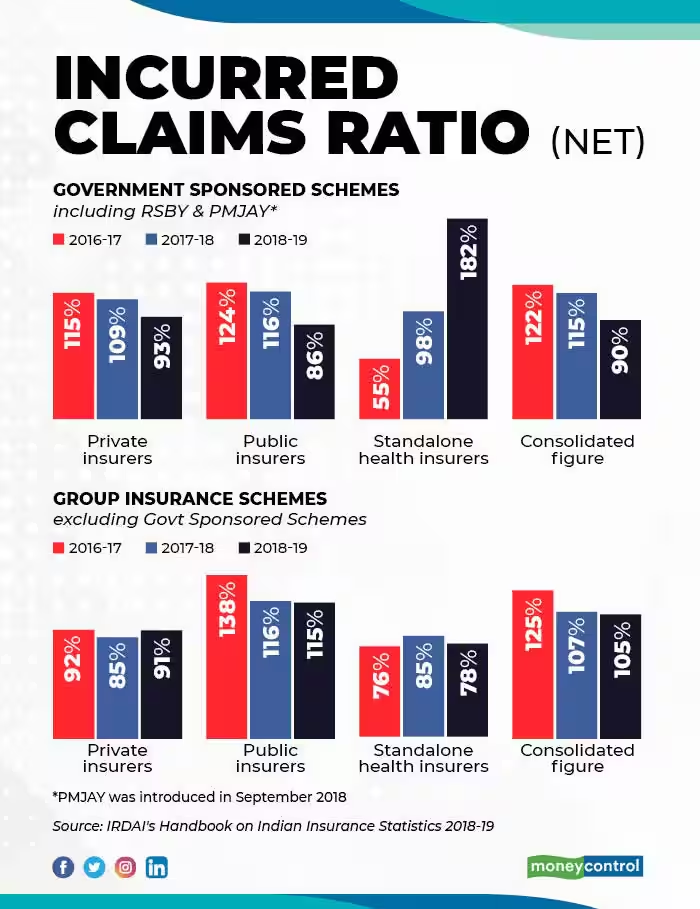
In India, the Insurance Regulatory and Development Authority of India (IRDAI) publishes annual ICR data of all health insurers.
This information is available in:
- Annual reports
- Official insurance disclosures
- Regulatory filings
Always refer to official sources or company annual reports for updated figures.
How to Use ICR While Buying Health Insurance
Here’s a practical approach:
Step 1: Shortlist insurers with good claim settlement ratio (Above 95%)
Step 2: Check their ICR
Choose insurers with ICR between 60% – 90%.
Step 3: Compare:
- Network hospitals
- Waiting period
- Coverage limits
- Sub-limits
- Co-payment clauses
Step 4: Review claim experience
Look for real customer reviews and grievance ratios.
ICR should not be the only factor, but it must be one of the deciding parameters.
Does Higher ICR Mean Better Insurance?
Not always.
- Very low ICR → May indicate claim rejections or low payouts.
- Very high ICR → May indicate underwriting losses.
Balanced ICR shows stability.
As an investor and policy analyst, I always recommend choosing financially stable insurers rather than just cheapest premium providers.
Practical Scenario: Understanding ICR with Real-Life Logic
Imagine two insurance companies:
Company A:
- Premium Collected: ₹100 crore
- Claims Paid: ₹85 crore
- ICR: 85%
Company B:
- Premium Collected: ₹100 crore
- Claims Paid: ₹120 crore
- ICR: 120%
Company A looks financially balanced.
Company B may be aggressive in claim payouts but might increase premiums soon to control losses.
This is why ICR should be viewed in context, not isolation.
How ICR Impacts Future Premiums
If insurer continuously shows:
- High ICR → Premium hikes likely.
- Low ICR → Stable pricing possible.
- Extremely low ICR → Risk of strict claim scrutiny.
Insurance works on risk pooling. If claims rise significantly, insurers must adjust premiums to maintain solvency.
Importance of ICR in Health Insurance vs Other Insurance Types
ICR is particularly important in:
- Health insurance
- Motor insurance
- General insurance
In health insurance, medical inflation directly impacts claim payouts. Therefore, ICR trends over 3–5 years give better understanding than a single year’s number.
Expert Advice: How to Interpret ICR Smartly
✔️ Check 3-year average ICR
✔️ Compare with industry average
✔️ Look at solvency ratio of insurer
✔️ Check grievance ratio
✔️ Don’t ignore policy terms
Insurance buying is not just about numbers. It’s about reliability during medical emergencies.
Common Mistakes People Make While Evaluating ICR
- Choosing insurer with highest ICR blindly.
- Ignoring claim settlement ratio.
- Not checking policy exclusions.
- Assuming high ICR guarantees easy claims.
- Ignoring long-term sustainability.
Avoid these mistakes to make smarter decisions.
Why Financial Literacy About ICR is Important
Health emergencies are unpredictable. A wrong insurance choice can result in:
- Claim rejection
- Financial stress
- Unexpected out-of-pocket expenses
Understanding ICR empowers you to:
- Evaluate insurers scientifically
- Avoid marketing traps
- Make informed financial decisions
Financial awareness is the foundation of wealth protection.
Frequently Asked Questions (FAQ)
1. What is a good incurred claim ratio?
An ICR between 60% and 90% is generally considered healthy and sustainable.
2. Is higher ICR always better?
No. Extremely high ICR (above 100%) may indicate financial losses and possible future premium hikes.
3. What if ICR is below 50%?
It may suggest lower claim payouts or strict claim approval policies.
4. Who publishes ICR data in India?
The Insurance Regulatory and Development Authority of India (IRDAI) publishes annual insurer reports.
5. Should I choose insurance only based on ICR?
No. Also consider claim settlement ratio, network hospitals, coverage benefits, waiting period, and policy terms.
6. What is the difference between ICR and claim settlement ratio?
ICR shows premium-to-claim payout ratio, while claim settlement ratio shows percentage of claims approved.
7. Does ICR change every year?
Yes. It depends on premium collection and claims paid during that financial year.
8. Can high ICR lead to premium increase?
Yes, if consistently above 100%, insurers may revise premiums.
