
As Budget 2026 approaches, taxpayers across India are asking one important question:
Where will the new tax amendments land — in the old Income Tax Act, 1961 framework, or under the newly structured Income Tax Act, 2025?
This transition marks one of the most significant structural changes in India’s taxation history. While many people expect headline tax relief or revised slabs, the real story lies deeper in the shift from a section-based law to a schedule-based, restructured tax architecture.
In this detailed guide, we decode what this means for salaried individuals, business owners, investors, and high-income taxpayers.
Understanding the Structural Shift: 1961 Act vs 2025 Act
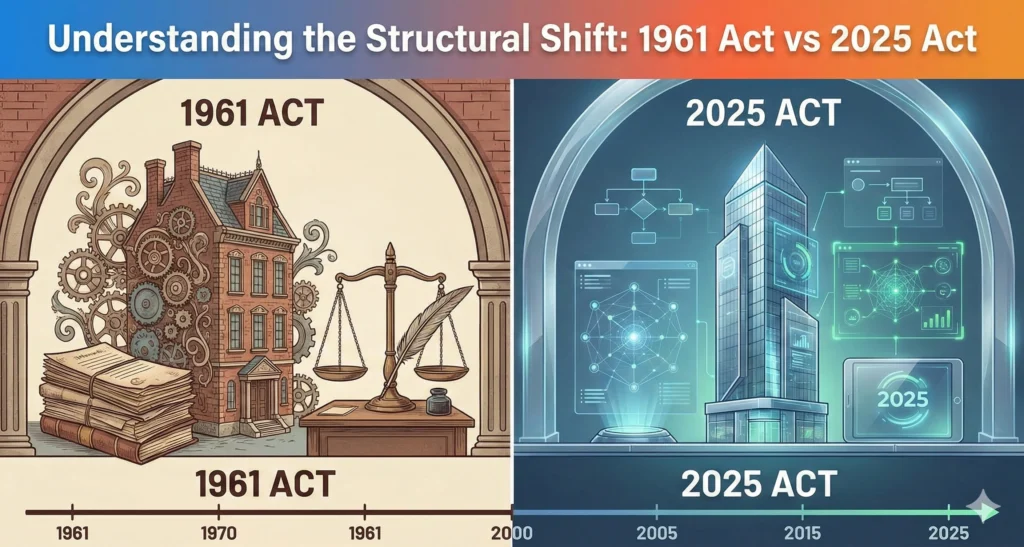
For decades, India’s tax system operated under the Income Tax Act, 1961, a law that gradually became complex due to numerous amendments, provisos, explanations, and cross-references.
The newly introduced Income Tax Act, 2025 aims to simplify the framework without necessarily changing tax burdens immediately. The difference is architectural rather than dramatic.
Key Structural Differences
| Old System (1961 Act) | New System (2025 Act) |
|---|---|
| Section-based reliefs | Schedule-based entitlements |
| Fragmented deductions | Consolidated tables |
| Multiple cross-references | Cleaner drafting |
| Heavy reliance on notifications | Embedded statutory design |
This means Budget 2026 changes are more likely to be introduced directly within the 2025 Act framework rather than retrofitted into the older structure.
Section Numbers to Structured Codes: What It Means for You
Under the 1961 Act, taxpayers were familiar with popular sections like:
- Section 80C (investments)
- Section 10 (exemptions)
- Section 24(b) (home loan interest)
- Section 87A (rebate)
- Section 115BAC (new tax regime)
The 2025 Act reorganizes these provisions into structured schedules.
Migration Snapshot
- Section 80C → Schedule XV
- HRA (Section 10(13A)) → Schedule III
- LTA (Section 10(5)) → Schedule III
- Home loan interest (Section 24(b)) → Section 22
- New Tax Regime (115BAC) → Section 202
- Rebate (87A) → Section 156
The benefits may remain similar, but the format has changed. This reduces interpretation disputes and aims to enhance administrative clarity.

Salary Income: Consolidation Under a Unified Structure
Under the 1961 Act, salary-related deductions were scattered across multiple sections.
The 2025 Act consolidates salary components into a structured framework under a single comprehensive chapter.
Included Components
- Standard deduction
- Gratuity
- Leave encashment
- Voluntary retirement compensation
- Employer retirement contributions
This consolidation ensures:
✔ Simplified compliance
✔ Reduced ambiguity
✔ Clear statutory backing
✔ Less dependence on circulars
From a professional tax advisory perspective, this is a positive reform that enhances certainty.
HRA, LTA & Special Allowances: A Big Structural Change
Historically:
- HRA was governed by Section 10(13A)
- LTA under Section 10(5)
- Special allowances under Section 10(14)
These were deeply embedded in the statute and backed by detailed rules.
Under the 2025 Act:
- HRA → Schedule III (Serial No. 11)
- LTA → Schedule III (Serial No. 8)
- Special Allowances → Schedule III (Serial Nos. 12 & 13)
What Has Changed?
The benefit continues. However, instead of being part of a rigid statutory section, it now operates within a schedule-based entitlement model.
This provides:
- Greater flexibility for future modifications
- Easier updates without rewriting core law
- Simplified drafting
However, it may also increase rule-based dependencies in the future.
Sections 80C, 80D & 80CCD: Investment & Insurance Deductions
Tax-saving investments have long been the backbone of Indian tax planning.
Earlier Structure
- 80C → ELSS, PPF, LIC, EPF
- 80D → Health insurance
- 80CCD → NPS contributions
Under the new Act:
These deductions migrate into Schedule XV, with enabling sections (123, 124, 126).
Important Observation
The design changes from a self-contained chapter to a schedule-based framework.
This allows:
- Centralized updating
- Structured eligibility criteria
- Cleaner interpretation
For long-term planners, the deduction framework remains, but the presentation is modernized.
House Property: Home Loan Interest & Concessions
Home loan interest deduction under Section 24(b) was a widely used benefit.
Under the 2025 Act:
- Interest deduction appears under Section 22
- Design logic is codified clearly
- Embedded relief for up to two self-occupied properties continues
What’s different?
Instead of loosely connected caps and interpretations, the relief is more precisely drafted with explicit conditions.
From a compliance standpoint, this reduces ambiguity in tax scrutiny cases.
Gifts & ‘Other Sources’ Income
Previously governed under Section 56(2)(x), gift taxation rules often led to confusion.
The 2025 Act restructures this under Section 92.
Key Features:
- Clear charging provision
- Defined exemptions
- Recognition of digital asset foresight
- Retention of gift rules from relatives
The explicit inclusion of valuation rules improves clarity.
However, certain grey areas around extended family definitions may continue to be debated.
Old Tax Regime vs New Tax Regime: What Changes in 2026?
The optional tax regime introduced under Section 115BAC continues in spirit.
Under the 2025 Act:
- New regime → Section 202
- Rebate → Section 156
Lower slab rates remain attractive but restrict deductions.
The 2025 Act does not drastically change the old vs new regime debate — but simplifies structure.
Taxpayers must still evaluate:
- Deduction-heavy portfolio?
- Simple salaried structure?
- High investment discipline?
Professional advice remains essential here.
Why Budget 2026 Is Different
Budget 2026 is not merely about tax slabs.
It represents:
- A shift from interpretation-heavy drafting
- To schedule-driven clarity
- With structural modernization
Legislative logic now dictates that future amendments will align with the 2025 Act rather than patching the 1961 framework.
This ensures forward consistency.
Expert Perspective: What Taxpayers Should Watch
From a financial advisory standpoint, here’s what matters most:
- Watch enabling provisions in schedules.
- Expect clarificatory rules in early implementation phase.
- Understand that benefit continuity ≠ format continuity.
- Keep documentation stronger than ever.
- Re-evaluate tax regime choice annually.
The structure is modern. Compliance discipline becomes more important.
Final Thoughts
The Income Tax Act, 2025 is not about removing benefits — it is about reorganizing them.
Budget 2026 will likely introduce refinements within this new structure rather than altering tax philosophy dramatically.
For taxpayers, the message is clear:
Understand the framework shift. Don’t panic about section numbers changing. Focus on eligibility and compliance.
Structural simplification, if implemented effectively, could reduce litigation and improve transparency in India’s tax system.
Frequently Asked Questions (FAQs)
1. Is the Income Tax Act, 1961 completely replaced?
The 2025 Act restructures the framework. Operational enforcement may be phased, but legislative design shifts to the new structure.
2. Are deductions like 80C removed?
No. They are migrated to structured schedules under the 2025 Act.
3. Will HRA and LTA continue?
Yes. Benefits remain but are placed under Schedule III.
4. Has the new tax regime changed?
It continues with structural renumbering under Section 202.
5. Is Budget 2026 expected to increase tax slabs?
Structural reform is the focus; slab changes remain speculative.
6. Is home loan interest deduction removed?
No. It is codified under Section 22 in the new framework.
7. What about rebate under 87A?
It is migrated under Section 156.
8. Are gift rules modified?
Gift taxation shifts under Section 92 with clearer charging structure.
9. Should taxpayers switch regimes in 2026?
Depends on individual deduction profile and income structure.
10. Is compliance expected to become simpler?
Yes, due to consolidated drafting and reduced cross-referencing.
