
Summary
-
India’s market has grown, but SEBI’s fixed large-cap, mid-cap, and small-cap definitions are outdated. Experts recommend revising the buckets to better reflect today’s market size and company valuations.
The structure of India’s stock market has evolved rapidly over the past decade. Market capitalisations have grown exponentially, and the distribution between large-cap, mid-cap, and small-cap stocks has shifted dramatically.
Despite this transformation, the current SEBI definition of market-cap categories remains unchanged, leading to skewed classifications and potential misrepresentation for investors.
This blog explores why there is a growing need to Time to Expand Market Cap Buckets and the possible alternatives that could ensure fairer representation for Indian companies.

Why the Current Market Cap Definition Needs a Re-Look
According to SEBI’s existing rules:
- Top 100 companies = Large-cap
- 101–250 ranked companies = Mid-cap
- 251 and beyond = Small-cap
However, the market has changed drastically:
- India now has far more companies with higher market capitalisation.
- Market leadership is constantly shifting.
- Several mid-cap stocks are now stronger, more stable, and widely traded than some traditional large-caps.
Yet, the categorisation structure has not evolved with the market reality. This creates a mismatch between investor expectations and actual company sizes.
Changing Makeup of Markets
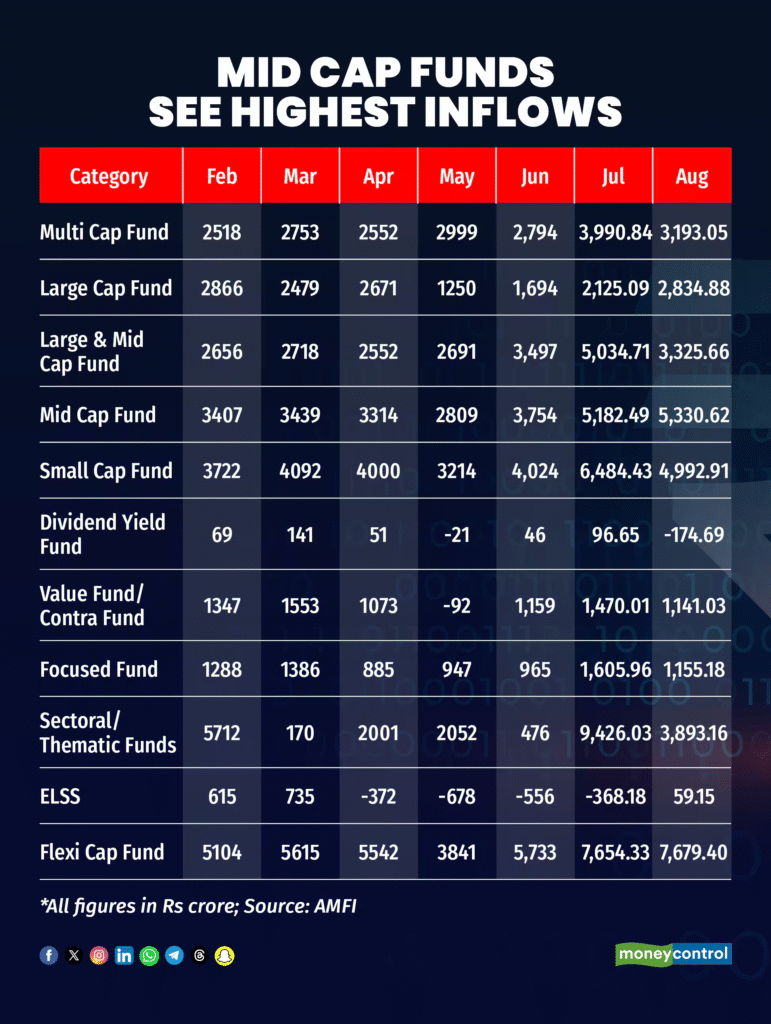
AMFI data shows how dramatically the weightage of categories has changed over the years.
Large-cap categories are absorbing a disproportionate share of funds due to rigid classifications, while many deserving high-value companies remain stuck in the mid-cap basket.
Key Observations
- Market cap growth has outpaced the category thresholds.
- Large-caps include some companies which barely remain in the top 100.
- Mid-caps now include several companies that are operationally larger than older large-caps.
Because the economy has expanded, the top 100 list no longer fully reflects true ‘large-cap’ status.
Percentage Share of Large-Cap, Mid-Cap & Small-Cap Stocks
Below is an approximate summary inspired by the data shown in the article:
| Category | 2015 | 2018 | 2020 | 2022 | 2024 | Median |
|---|---|---|---|---|---|---|
| Large-cap share | 70% | 72% | 69% | 67% | 64% | 68.5% |
| Mid-cap share | 17% | 16% | 18% | 19% | 21% | 18.2% |
| Small-cap share | 13% | 12% | 13% | 14% | 15% | 13.4% |
This shows how the weight distribution has shifted and why rigid boundaries may not reflect actual market growth.
Possible Alternatives for Better Categorisation
Alternative 1: Percentile-Based Method
Instead of fixed numbers (100, 250), SEBI could adopt a percentile-based approach.
Example:
- Top 15% of companies → Large-cap
- Next 17.5% → Mid-cap
- Remaining → Small-cap
This method automatically adjusts with:
✔ Market growth
✔ Increase in listed companies
✔ Changing investor behaviour


Alternative 2: Expanding Market-Cap Buckets
Another approach is to redefine bucket counts.
| Market Cap Rank | Current Category | Proposed Category |
|---|---|---|
| 1–100 | Large-cap | 1–125 (Large-cap) |
| 101–250 | Mid-cap | 126–300 (Mid-cap) |
| 251 onwards | Small-cap | 301 onwards (Small-cap) |
This gives breathing room for:
- Growing companies
- Reducing artificial crowding in the mid-cap segment
- More accurate representation of company sizes
Why This Matters
Redefining market cap buckets will help:
- Mutual funds allocate assets more fairly
- Investors understand company categorisation better
- Fast-growing firms avoid being ‘misplaced’ in small-cap or mid-cap categories
- Reduce distortions in index creation and fund benchmarks
It also ensures India’s growing corporate landscape is represented fairly and transparently.
The Indian stock market has evolved, but its market-cap classification framework has not kept up. With companies scaling faster than before, SEBI may need to consider expanding or redefining market cap buckets using percentile or expanded-range methods.
A modernised classification system will support:
- Better fund management
- Accurate market representation
- Improved investor awareness
As markets mature, updating the system is not just a suggestion — it is a necessity.
FAQs on Market Cap Categorisation
What is a market cap bucket?
It refers to categories (large-cap, mid-cap, small-cap) used to group companies based on their total market value.
Why is SEBI’s current definition facing criticism?
Because it uses fixed counts (top 100, next 150, etc.) that do not reflect India’s rapidly expanding market ecosystem.
What problems occur due to fixed categorisation?
Small companies with high valuations stay in mid-cap, and declining companies may still remain in large-cap — causing misrepresentation.
How will percentile-based categorisation help?
It adjusts dynamically as the number of listed companies grows, ensuring fairer segmentation.
What is the proposed new large-cap cutoff?
Experts suggest expanding it from top 100 to top 125 companies.
Will this impact mutual fund portfolios?
Yes. Allocations will become more balanced and representative of the real market structure.
Is redefining market cap buckets necessary now?
With rising valuations and more listed companies, updating the framework is highly recommended.
