Summary
-
Foreign Institutional Investors (FIIs) play a crucial role in shaping India’s stock market, with the US alone accounting for over 41% of total FII assets under custody. In 2024–25, global uncertainty, trade tensions, and US tariff hikes triggered heavy volatility in Indian equities. While sectors like IT and pharma faced pressure, domestic fundamentals such as strong consumption, stable earnings, and supportive government reforms helped cushion the impact. Experts believe that despite short-term market swings driven by global events, India’s long-term equity outlook remains positive, powered largely by internal economic strength and rising domestic investor participation.
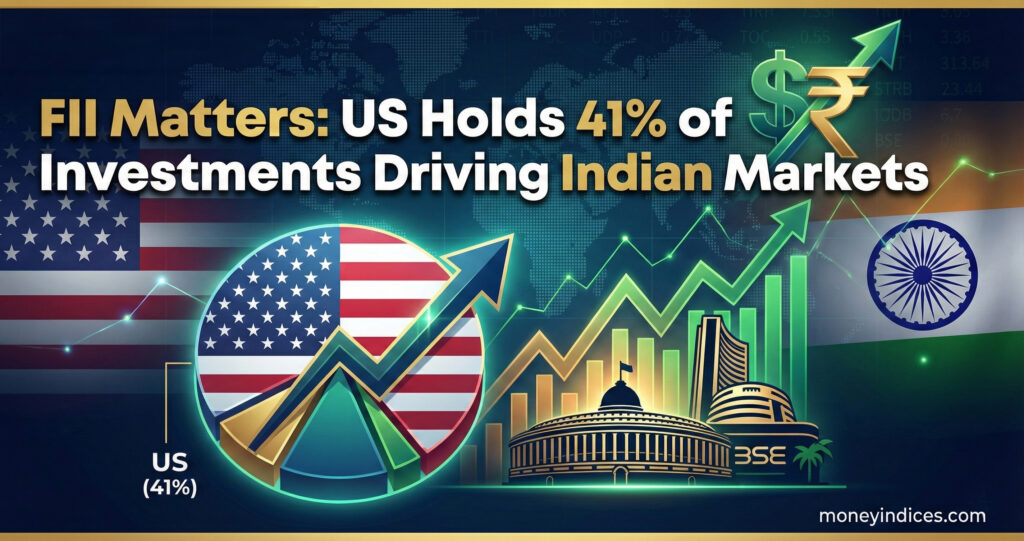
Foreign Institutional Investors (FIIs) play a major role in influencing India’s equity markets. With the United States alone accounting for over 41% of total FII assets under custody, global economic tensions, tariffs, and sentiment shifts significantly impact market performance in India.
In this blog, we break down how FIIs are distributed across various countries, how global trade uncertainty has affected market movements in 2024–25, and what investors should expect going forward.
FII Matters | FII Investment Share by Country
Here’s the approximate distribution of global investors contributing to the Indian market:
- 🇺🇸 United States – 41%
- 🇫🇷 France – 2%
- 🇨🇦 Canada – 3%
- 🇯🇵 Japan – 3%
- 🇳🇴 Norway – 4%
- 🇬🇧 UK – 5%
- 🇲🇺 Mauritius – 5%
- 🇮🇪 Ireland – 6%
- 🇱🇺 Luxembourg – 7%
- 🇸🇬 Singapore – 8%
- 🌎 Other Countries – 16%
This clearly shows the dominant influence of US investors. Any policy change, tariff imposition, or economic shift in the US directly affects Indian equity flows.


Impact of FII Movements on Indian Equity Markets

Over the past year, Indian markets have witnessed significant volatility due to global uncertainties and domestic policy developments. Let’s break down the journey.
Early 2024: Volatility Due to Geopolitical Concerns
At the beginning of the year, FIIs turned net sellers due to:
- Global geopolitical conflicts
- Uncertain trade negotiations
- Fear of recession in developed economies
Even though domestic institutional investors (DIIs) provided some cushion, FII sell-offs triggered sharp declines in Indian indices.
April–June: Temporary Recovery After US Tariff Relaxation
A short-term rebound occurred after:
- 90-day pause on US tariffs on India
- Bilateral trade negotiations with countries like Japan, UK, Vietnam
- Positive expectations around India’s macroeconomic strength
Indian markets stabilized briefly, and indices posted healthy gains.
August–September: Tariff Shock & Market Slide
However, sentiment weakened again when:
- The US imposed an additional 25% tariff on Indian imports
- Pharma, IT, and export-oriented sectors faced pressure
- Nifty IT and Nifty Pharma fell over 2–2.4%
Economists noted that even though domestic fundamentals were strong, tariff-related uncertainty spooked investors.
The GST Boost & Aftermath
Government announcements related to GST 2.0 restored temporary confidence among investors.
But soon after, a:
- Steep hike in H-1B visa fees,
- Slowdown in global demand, and
- Declining export numbers
pushed market sentiment downward again.
Sensex and Nifty both slipped by around 1%, reflecting the broader weakness.
Key Expert Insights
1. Domestic fundamentals remain strong
Economists highlight that:
- Indian consumption is resilient
- Corporate earnings are stable
- Inflation is under control
- Long-term structural growth remains intact
2. Global factors will continue to influence market direction
Tariffs, trade wars, and monetary policy decisions from the US will continue to affect FII flows.
3. Long-term investors need not panic
Even if US-bound exports decline, fundamentally strong Nifty companies will remain stable.
A calculation mentioned by analysts suggests:
- If US exports fall by 70%,
- Nifty 500 impact may be just –1.6%.
That means India’s market remains structurally strong.
The Way Forward for Indian Equities
Despite tariff pressures and global uncertainty, India’s domestic growth story remains robust. The long-term outlook for Indian equities continues to be positive due to:
- Strong domestic consumption
- Reforms like GST improvements
- Government infrastructure push
- Increasing retail investor participation
While FIIs can influence short-term volatility, long-term wealth creation depends more on India’s internal economic strength.
FAQs on FII Impact on Indian Stock Market
What are Foreign Institutional Investors (FIIs)?
FIIs are overseas entities such as mutual funds, hedge funds, insurance companies, and banks that invest in Indian financial markets.
Why do FIIs matter so much for the Indian market?
FIIs bring large volumes of capital. Their buying increases market liquidity and boosts indices, whereas heavy selling triggers corrections.
Which country contributes the most to FII investment in India?
The United States, contributing over 41% of total FII assets under custody.
How do global events impact FII inflows?
Global recessions, trade wars, interest rate hikes, and geopolitical tensions often cause FIIs to withdraw funds from emerging markets like India.
Will US tariffs hurt Indian stocks in the long term?
Short term: Yes, especially export-heavy sectors.
Long term: Not significantly, as India’s growth is increasingly domestic-led.
Why were IT and Pharma sectors hit the most?
These sectors earn a major portion of their revenues from the US. So, tariffs and visa restrictions directly impact their earnings outlook.
Are domestic investors helping stabilize the market?
Yes. Retail and domestic institutional investors (DIIs) have grown significantly and now absorb a large part of FII outflows.
Should retail investors worry about FII selling?
Not always. FII selling generally affects short-term market movements. Long-term investors should focus on India’s structural growth.
