
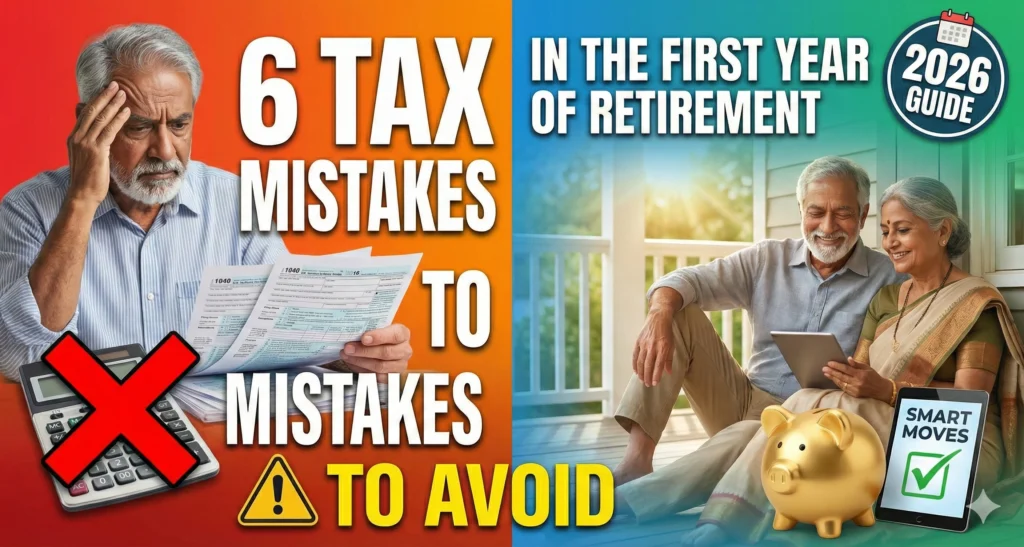
Retirement is supposed to be a time of relaxation, financial stability, and freedom from workplace stress. However, what many retirees don’t realize is that the first year of retirement can be one of the most tax-sensitive periods of their financial life.
A simple mistake during this transition phase can increase your tax liability, trigger penalties, or even attract notices from the Income Tax Department.
After working with retirees and analyzing common tax filing errors over the years, we have identified 6 Tax Mistakes to Avoid in the First Year of Retirement. This guide breaks down everything clearly — with practical explanations and tax treatment insights.
Why the First Year of Retirement Is Tax-Critical. Read 6 Tax Mistakes to Avoid in the First Year of Retirement
When you retire:
- Salary income stops
- Multiple retirement benefits begin
- Pension starts
- Provident Fund or gratuity may be received
- Investment income structure changes
This sudden shift from one salary income to multiple income streams often creates confusion.
Many retirees assume that tax compliance becomes easier after retirement. In reality, tax complexity often increases.
Mistake #1: Not Filing Income Tax Returns
One of the most common and avoidable mistakes is assuming that retirement means you no longer need to file income tax returns.
Why This Is Risky
Even if:
- Your salary has stopped
- Pension is below taxable limit
- Banks deduct TDS
You may still need to file returns.
When Filing Is Mandatory
For senior citizens (60–79 years):
- Filing is mandatory if total income exceeds basic exemption limit.
For super senior citizens (80+):
- Higher exemption applies, but filing may still be required.
Also remember:
- If TDS is deducted from pension or FD interest, filing is necessary to claim refunds.
- Late filing attracts penalties.
- Delayed filing can affect carry-forward of losses.
Pro Tip: Even if income is below the threshold, filing returns helps maintain a financial record useful for loans, visas, or future compliance.
Mistake #2: Assuming All Retirement Benefits Are Tax-Free
Many retirees believe:
“Gratuity, pension, EPF, NPS — everything is tax-free.”
This is not entirely correct.
Let’s understand the taxation clearly.
How Are Retirement Benefits Taxed?
1. Gratuity
- Tax-exempt up to prescribed limits.
- Amount exceeding the exemption is taxable.
- Government employees enjoy full exemption.
2. Pension
- Uncommuted pension (monthly pension): Fully taxable as salary.
- Commuted pension: Partially exempt depending on employment type.
3. Family Pension
- Taxed under “Income from Other Sources.”
- Deduction allowed: Lower of ₹25,000 or one-third of pension.
4. NPS (National Pension System)
- 60% of corpus is tax-exempt at withdrawal.
- Annuity income is fully taxable.
- Additional lump sum withdrawals may be taxable beyond limits.
5. Annuity Income
- Fully taxable.
- No standard deduction benefit.
6. EPF
- Maturity tax-free after 5 years of service.
- Early withdrawal may attract tax.
- Large withdrawals without PAN may face higher TDS.
7. PPF
- Fully exempt (EEE status).
- Interest and maturity are tax-free.
Key Insight: Not all retirement receipts are tax-free. Understanding tax classification prevents surprises.
Mistake #3: Not Reporting All Income Sources
Retirement often replaces salary with:
- Pension
- Interest income
- Rental income
- Capital gains
- Annuity
- Dividend income
Many retirees forget to report:
- FD interest from multiple banks
- Post office deposits
- Small savings schemes
- Capital gains from redeemed mutual funds
The Income Tax Department receives data from banks and financial institutions.
If income is not reported:
- Notice may be issued
- Penalty and interest may apply
Best Practice: Always download Form 26AS and Annual Information Statement (AIS) before filing returns.
Mistake #4: Ignoring Advance Tax Liability
Once you retire, TDS deduction may reduce significantly.
If total tax liability exceeds ₹10,000 in a financial year, you must pay advance tax in installments.
Failing to pay advance tax can result in:
- Interest under Section 234B
- Interest under Section 234C
Many retirees depend on interest income and assume TDS covers everything. Often, it doesn’t.
Mistake #5: Poor Withdrawal Planning from Retirement Corpus
Taking large lump-sum withdrawals in one financial year can push you into a higher tax slab.
For example:
- Large NPS withdrawal
- Selling property
- Redeeming mutual funds
Better strategy:
- Spread withdrawals over multiple financial years.
- Combine tax planning with cash flow planning.
- Align withdrawals with slab benefits.
Retirement is about income optimization, not just tax saving.
Mistake #6: Not Optimizing Senior Citizen Tax Benefits
Senior citizens enjoy special benefits:
- Higher exemption limits
- Higher deduction under Section 80D (medical insurance)
- TDS exemption via Form 15H (if applicable)
- Special provisions under Section 194P (for eligible 75+ seniors)
Many retirees are unaware of these provisions and end up paying excess tax.
Consulting a tax advisor in the first retirement year can help structure income efficiently.
Real-Life Retirement Tax Scenario
Let’s consider an example:
Mr. Sharma retires at 62.
He receives:
- Gratuity: ₹15 lakh
- PF withdrawal: ₹25 lakh
- Monthly pension: ₹45,000
- FD interest: ₹3 lakh annually
- Rental income: ₹2 lakh annually
He assumes everything except rent is tax-free.
Reality:
- Pension fully taxable
- FD interest taxable
- Rental income taxable
- Part of gratuity may be taxable (if exceeding limit)
Without planning, he may fall into a higher slab and pay unnecessary tax.
Why Retirement Tax Planning Requires Expertise
The retirement phase combines:
- Income tax law
- Investment planning
- Withdrawal strategy
- Estate planning
A mistake in classification can cause long-term impact.
Professional guidance helps:
- Reduce tax legally
- Optimize withdrawals
- Avoid penalties
- Maintain compliance
Retirement is not just about savings — it’s about intelligent tax management.
Practical Checklist for First-Year Retirees
✔ File income tax return even if unsure
✔ Review AIS and Form 26AS
✔ Understand taxation of each retirement component
✔ Plan withdrawals across years
✔ Check advance tax liability
✔ Claim senior citizen deductions
✔ Maintain documentation of all receipts
Frequently Asked Questions (FAQs)
1. Do I need to file income tax return after retirement?
Yes, if your total income exceeds the basic exemption limit or if TDS has been deducted and you want a refund.
2. Is pension fully taxable?
Uncommuted (monthly) pension is fully taxable as salary. Commuted pension may be partially exempt depending on employment type.
3. Is gratuity completely tax-free?
Not always. It is exempt up to prescribed limits. Amount above that is taxable.
4. Is NPS withdrawal tax-free?
Up to 60% of corpus withdrawal is tax-free. Annuity income is fully taxable.
5. Do senior citizens have higher tax exemption limits?
Yes, senior and super senior citizens enjoy higher exemption limits under the Income Tax Act.
6. What happens if I don’t report FD interest?
Banks report interest income to the tax department. Non-reporting may lead to notices and penalties.
7. Do retirees need to pay advance tax?
Yes, if total tax liability exceeds ₹10,000 in a financial year.
8. Is EPF withdrawal taxable after retirement?
If you have completed 5 years of service, maturity is generally tax-free.
