
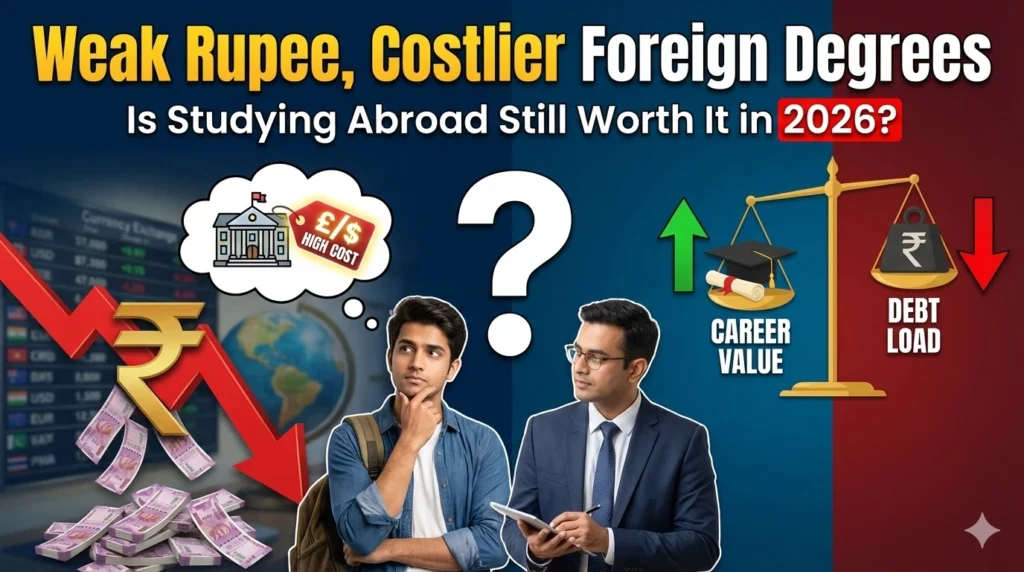
Studying Abroad Still Worth It in 2026 has long been a dream for Indian students. A degree from the United States, United Kingdom, Canada, or Australia has traditionally promised global exposure, better job prospects, and long-term career growth.
But in 2026, that dream is becoming significantly more expensive.
With the Indian rupee weakening against the US dollar and other major currencies, rising global inflation, increasing tuition fees, and stricter visa rules, families are rethinking overseas education plans. What once looked like a ₹60–75 lakh financial commitment is now easily crossing ₹1–1.5 crore for many students.
In this article, we break down:
- How rupee depreciation is increasing foreign education costs
- The real impact of inflation on tuition and living expenses
- Why education loans are rising sharply
- Visa challenges in the US, UK, and Canada
- Smart strategies to plan your overseas education fund
The Rupee Effect: Why Currency Depreciation Matters
Over the past two years, the Indian rupee has steadily depreciated against the US dollar.
For example:
- January 2024: Around ₹83 per USD
- January 2026: Around ₹90+ per USD
That may look like a small change on paper. But when you are paying tuition in dollars, pounds, or Australian dollars, even a ₹5–7 movement can increase your total cost by lakhs.
Example:
If your tuition fee is:
- $50,000 per year
At ₹83/USD → ₹41.5 lakh
At ₹90/USD → ₹45 lakh
That’s a difference of ₹3.5 lakh per year — purely because of currency movement.
Over a 2-year master’s program, that can mean an additional ₹7–10 lakh burden without any change in university fees.
Rising Tuition & Living Costs: Inflation Is Compounding the Problem
Currency depreciation is only one side of the story.
Global inflation has pushed:
- Tuition fees higher
- Accommodation costs up
- Food and transport expenses upward
- Health insurance and visa processing costs higher
Many top universities in the US and UK have increased annual tuition by 5–10% in recent years.
For example:
- A master’s degree that cost $60,000 two years ago may now cost $65,000–$70,000.
- Living expenses in cities like London, New York, Toronto, or Sydney have increased sharply due to housing shortages and rising rents.
When inflation and currency depreciation combine, the cost escalation becomes severe.


Real Stories: How Families Are Reassessing Their Plans
Many middle-class families had originally planned for overseas education assuming costs of ₹50–75 lakh. But current estimates are crossing ₹1 crore in many cases.
Common situations include:
- Students postponing plans by 1–2 years
- Switching from the US to countries like Germany or Singapore
- Considering public universities instead of private ones
- Choosing 1-year programs instead of 2-year courses
- Dropping MBA plans due to high ROI uncertainty
The emotional cost is also significant. For parents, overseas education is often a lifetime goal for their children. Rising uncertainty is creating financial stress and anxiety.
Education Loans: Becoming a Lifeline
Savings alone are no longer enough for most families.
Between 2021 and 2024, the average education loan ticket size increased significantly. Many students now require:
- ₹60–80 lakh loans for undergraduate programs
- ₹80 lakh–₹1.2 crore loans for postgraduate programs in the US
EMI Pressure Example:
Loan Amount: ₹80 lakh
Interest Rate: 10%
Tenure: 10 years
EMI could exceed ₹1 lakh per month.
Lenders are now strictly evaluating:
- Parent’s income
- Fixed obligations to income ratio (FOIR)
- Co-applicant credit score
- Collateral security
For many families, eligibility itself becomes a challenge.
Visa Tightening: The 2026 Shock
In addition to cost pressures, visa regimes have tightened.
United States
- Stricter scrutiny for F-1 student visas
- Increased documentation checks
- Greater monitoring of work permits (OPT/H1B pathways)
Canada
- Higher rejection rates for student visas
- Stricter financial proof requirements
- Caps on international student intake
United Kingdom
- Restrictions on dependent visas
- Reduced post-study work duration discussions
- Higher maintenance fund requirements
Visa uncertainty increases financial risk. If a visa is rejected after tuition deposits are made, families can face significant losses.
Is Studying Abroad Still Worth It in 2026?
The answer depends on three factors:
1. Career ROI (Return on Investment)
Ask:
- What is the expected salary after graduation?
- Is the course aligned with high-demand sectors?
- What are post-study work opportunities?
Fields like:
- Computer Science
- AI & Data Science
- Healthcare
- Finance & Quantitative fields
still offer strong ROI if planned carefully.
2. Total Cost vs Earning Potential
If your total cost is ₹1.2 crore, and expected annual salary is ₹60–70 lakh abroad, ROI may justify the investment.
But if:
- Degree cost = ₹1 crore
- Expected salary = ₹25–30 lakh equivalent
then payback may take too long.
3. Alternative Options in India
India now offers:
- Top IITs, IIMs, ISB
- Global tie-up programs
- International faculty exposure
- Growing startup ecosystem
In some cases, pursuing a high-quality Indian degree plus global certifications may be more financially prudent.
Smart Financial Planning Strategies
As finance professionals, here’s what we recommend:
1. Start SIP Early
Begin investing through Systematic Investment Plans (SIPs) when your child is young.
If you invest ₹15,000/month for 15 years at 12% returns:
You can build a corpus of ₹70–75 lakh.
Time is your biggest advantage.
2. Diversify with International Exposure
Since foreign education expenses are in foreign currency:
- Allocate a portion of investments to international mutual funds or ETFs.
- This acts as a hedge against rupee depreciation.
3. Target Realistic Corpus
Current estimates:
Undergraduate in US/UK:
₹1–1.5 crore
Master’s in US:
₹70 lakh–₹1.2 crore
MBA from top schools:
₹1.5 crore+
Plan conservatively, assuming currency depreciation.
4. Compare Countries Strategically
More affordable destinations include:
- Germany (low tuition)
- France
- Netherlands
- Singapore
- Some Australian universities
Balance prestige with affordability.
5. Avoid Overleveraging
Taking a loan that requires 50% of future salary in EMIs is risky.
Financial stability matters more than brand value.
From a financial planning standpoint, overseas education must be treated as:
- A capital investment
- A currency exposure decision
- A debt management strategy
- A long-term wealth planning decision
Families who:
- Plan 10–15 years early
- Invest systematically
- Hedge currency risk
- Evaluate ROI rationally
are better positioned than those making last-minute emotional decisions.
The Psychological Cost
Beyond numbers, there’s emotional stress:
- Parents dipping into retirement savings
- Students feeling pressure to secure high-paying jobs immediately
- Fear of visa rejection
- Anxiety about currency fluctuations
Financial clarity reduces stress.
A well-planned approach replaces uncertainty with control.
Frequently Asked Questions (FAQ)
1. Why has studying abroad become more expensive recently?
Because of rupee depreciation, global inflation, rising tuition fees, higher living costs, and stricter visa requirements.
2. How much does a US master’s degree cost in 2026?
It can range from ₹70 lakh to ₹1.2 crore depending on university, location, and living expenses.
3. How does rupee depreciation impact education cost?
If the rupee weakens against the dollar, tuition and living costs increase in rupee terms even if the dollar cost remains the same.
4. Is taking an education loan of ₹1 crore risky?
It depends on post-graduation salary prospects. If expected earnings are strong and stable, it may be manageable. Otherwise, repayment pressure can be high.
5. Should parents start investing early for foreign education?
Yes. Starting SIPs 10–15 years early significantly reduces loan dependency and financial stress.
6. Which countries are more affordable for Indian students?
Germany, France, and some European nations offer lower tuition compared to the US and UK.
7. Is studying abroad still worth it in 2026?
Yes — but only if:
- Course ROI is strong
- Financial planning is disciplined
- Loan burden is manageable
8. How can families protect against currency risk?
By investing partly in international funds or assets linked to foreign markets.
