
Summary: Global ETFs in India are trading at high premiums due to demand-supply imbalance and regulatory limits. Buying at inflated prices can dilute returns or lead to losses when premiums normalise.
Global investing has become increasingly popular among Indian investors who want exposure to fast-growing international companies especially sectors like technology, artificial intelligence, consumer innovation, and digital platforms.
However, this rising demand, combined with regulatory restrictions on overseas mutual fund limits, has led to a new problem: global ETFs listed in India are trading at unusually high premiums.
This hidden premium creates a trap where investors unintentionally overpay, only to face diluted or negative returns later.
In this blog, we break down what the ETF premium trap is, why it is happening, and how investors can avoid falling prey to it.
What Is the Global ETF Premium Trap?
An ETF usually trades close to its NAV (Net Asset Value).
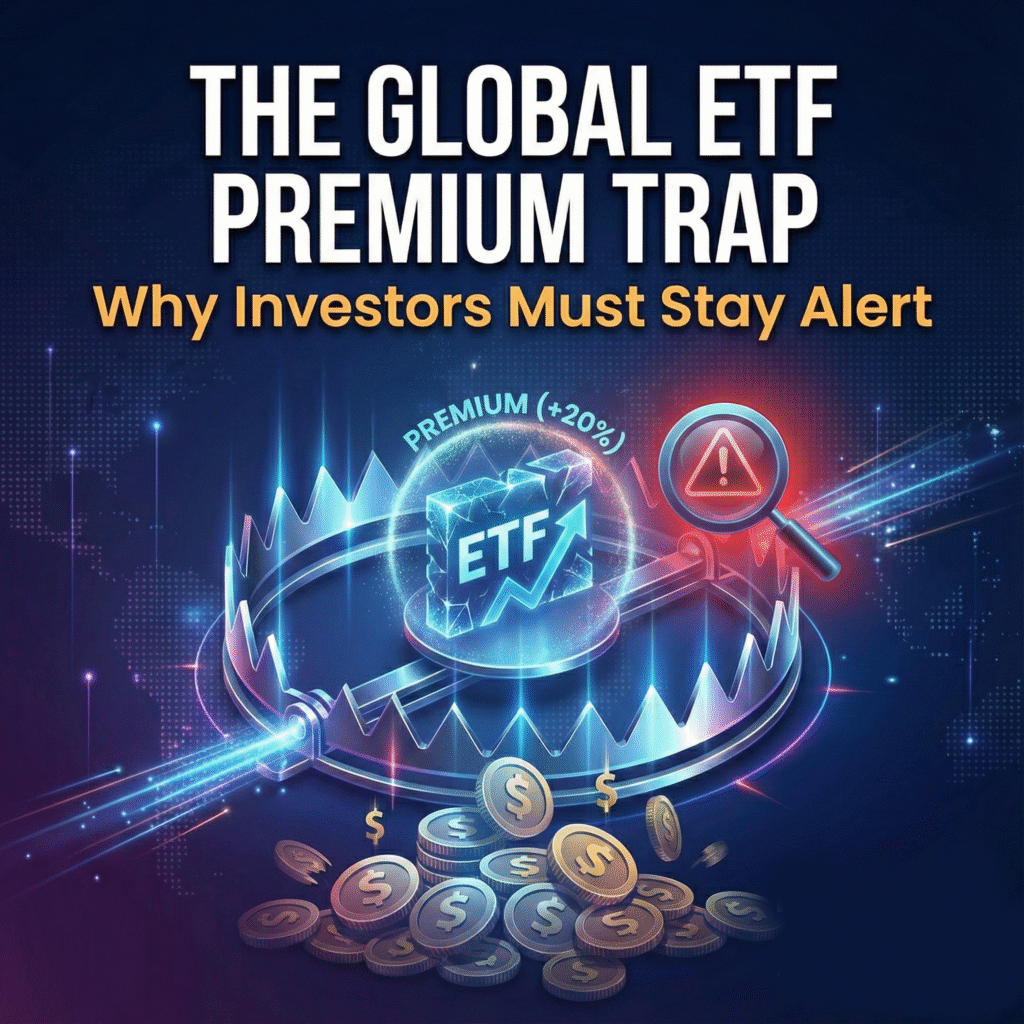
But when demand is extremely high — and fresh inflows are restricted — the ETF price in the Indian market shoots above its fair value.
This difference is called:
ETF Premium = ETF Market Price – NAV
Today many global ETFs in India are trading 10–25% above their NAV.
This means an investor buying today is paying much more than the actual value of the underlying global stocks.
Why Are Global ETF Premiums Rising?
1. Regulatory curbs on overseas investments
The RBI and SEBI limit how much Indian mutual funds can invest abroad.
Since most fund houses reached this cap in 2022, they paused new overseas investments.
No fresh units = Supply shortage
High demand = Premium shoots up
2. Over-demand for US tech & FANG stocks
ETFs holding popular names like:
…are seeing huge domestic demand — driving up prices.
3. Limited liquidity
Many global ETFs listed in India do not trade heavily.
Low liquidity + high demand = premium spike.
4. Sharp rallies in US markets
With US markets rising, Indian investors fear missing out and rush to buy global ETFs — even at inflated prices.
Pay More Today, Suffer Later
Paying a 10–20% premium may not seem harmful initially.
But as soon as the premium normalizes, the ETF price drops — even if the global market rises.
Example:
If NAV is ₹100
You buy at a 20% premium = ₹120
Even if NAV rises 10% to ₹110,
If premium falls to 0%, ETF price = ₹110
You still lose ₹10.
This is the ETF Premium Trap.
How Much Premium Are ETFs Currently Charging?
(Values rewritten from the article in simple format.)
| ETF Name | Premium (Approx) |
|---|---|
| Mirae Asset Hang Seng Tech ETF | ~20% |
| Mirae Asset NYSE FANG+ ETF | ~21% |
| Mirae Asset S&P 500 Top 50 ETF | ~21% |
| Motilal Oswal Nasdaq 100 ETF | ~7–8% |
| Motilal Oswal Nasdaq Q50 ETF | ~10% |
| Nippon India Hang Seng BeES | ~11–18% |
The FoF (Fund of Fund) Conundrum
Many investors assume that the FoF version (mutual fund format) will bypass the premium.
But FoFs also face the same limitation: since they cannot buy new overseas units, they end up investing in the same ETF traded at a premium.
Meaning:
ETF Premium → FoF NAV also becomes expensive
Thus FoFs too may deliver lower returns once the premium cools down.
What Happens When the Premium Falls?
If you buy an ETF at a high premium and the premium drops:
- Your returns will be reduced
- Or you may face a capital loss
- Even if global markets rise, the ETF price may remain flat
This is why experts advise caution.
What Should Investors Do?
✔ 1. Check ETF premium before investing
Invest only if the ETF is trading close to its NAV.
✔ 2. Avoid chasing high-flying global themes
Popularity doesn’t equal profitability.
✔ 3. Prefer low-cost index funds when limits reopen
Once overseas investment limits reset, NAV and price will align.
✔ 4. Use SIP instead of lumpsum
This reduces the risk of buying at peak premium.
✔ 5. Be ready to book profit
If you already hold global ETFs with high premium and markets are stable, consider taking partial profit.
✔ 6. Track FoF valuations separately
FoFs may look safer but also indirectly mirror ETF premiums.
Global investing is a smart strategy — but not at any cost.
Buying ETFs at inflated prices can significantly dilute your returns and increase downside risk.
As markets stabilize and regulations evolve, premiums will normalize.
Until then, investors must stay cautious, track NAV-to-price gaps, and avoid emotional buying.
Smart investing is not just about picking the right theme — but also paying the right price.
FAQ About the Global ETF Premium Trap
What is an ETF premium?
When the ETF market price is higher than its NAV, the difference is called a premium.
Why do global ETFs in India trade at a premium?
Due to high demand, low supply, and restrictions on new overseas investments by mutual funds.
Is it risky to buy an ETF at a premium?
Yes. If the premium drops later, you may face losses even if the global market rises.
Are FoFs safer than ETFs?
Not always. FoFs also end up buying units of ETFs trading at a premium, which affects NAV.
Will premiums eventually disappear?
Yes. Over time, prices converge to NAV. When that happens, the inflated portion disappears — affecting returns.
Should I sell if I already hold high-premium ETFs?
Consider partial profit booking or wait for premium normalization depending on your long-term goals.
